Leta i den här bloggen

onsdag 22 april 2015

Mietek Grocher

Mietek Grocher

Mietek Grocher syntyi vuonna 1926 Varsovassa. Hän on 88- vuotias juutalaisnenkirjailija ja luuennoitsija . Toisen maailmansodan aikana hänenkin kohtalokseen tuli joutua keskitysleriin  Holokaustin aikana. Toisesta maailmansodasta alkaen hän on asunut Ruotsisa, tällä hetkellä Tukholamssa. Muita asuinpaikkoja on ollut Köping ja Västerås.  Monet vuodet hän työskenteli ASEA.ssa.
Kun  Puolaan tapahtui invaasio, oli  Mietek Grocher 12 vuotias  poikanen  ja juuri silloin   kesäleirillä.  Hänen kirjojensa lehdiltä voi seurata hänen elämäänsä Varsovan ghetton kauhuista vapauteen ja uuden elämän alkuun Ruotsissa. .
Grocher kiertää nyt koulusta kouluun Ruotsisa kertoen  Holokaustin ajan muistoista. Vuonna 2009 hän piti 147 luentoa. Kirjaansa  Jag överlevde! ( Minä selvisin hengissä!) hän on koonnut sen ajanjaksonsa  muistot. Hän kertoo elämästään Varsovan ghettossa ja miten hänet internoitiin isänsä kanssa ja kuinka  he joutuivat yhdeksään eri keskitysleiriin ja miten Grocherin onnistui välttää kaasukammia,  mistä asiasta  on  paljon  väitelty. Grocher  joutui  kulkemaan yhdeksän keskitysleirin kautta ja niissä oli Majdanek ja Buchenwald.

Mietek Grocher, född 1926 i Warszawa, är en judisk föreläsare och författare som överlevde Förintelsen. Sedan andra världskriget är han bosatt i Sverige, nu boende i Stockholm men har varit bosatt i Köping sedan Västerås och arbetade på ASEA under flera år. Mietek var en helt vanlig 12-årig pojke på sommarkoloni när invasionen påbörjades av Polen. I hans bok får man följa honom från Warszawa ghettots fasor till friheten och ett nytt liv i Sverige.
Grocher reser runt i skolor i Sverige för att berätta om sina minnen av Förintelsen. Under 2009 höll han 147 föreläsningar[1]. I boken Jag överlevde! har han samlat sina minnen från den tiden. I den berättar han om hur han levde i Warszawas getto, internerades tillsammans med sin far, hur de följdes åt genom nio koncentrationsläger och hur Grocher lyckades rymma ur en gaskammare, vilket i sin tur är högst omdiskuterat. Grocher kom att vara i nio olika läger, däribland Majdanek och Buchenwald.

Elämäkerta, Bibliografi

  • Grocher, Mietek, Jag överlevde, Johanneshov: Inova 2001 (ny, reviderad upplaga 2011), ISBN 91-85996-41-6

Viiteitä , Referenser

  1.  ”Mietek Grocher överlevde Förintelsen” (på svenska). Östgötakuriren. 2010-03-11. Läst 2011-03 28.

Externa länkar

onsdag 1 april 2015

Temppeli-instituutin uutisista

http://www.israelnationalnews.com/News/News.aspx/193464
Temppeli-instituutin tutkijat ovat pystyneet  elvyttämään  tiedot pääsiäislampaan valmistuksesta  Temppelissä.

Tämä liharuoka oli yli 2000 vuotta sitten  tyypillistä pääsiäisen vietossa Mooseksen ajoista asti ,  samoin  viikon ajan syötävä happamaton leipä, matza. Myös Jeesus  pyysi opetuslapsia valmistamaan  pääsiäislampaan  heidän ryhmälleen ja he söivät sen Siionin vuorella.

  Jokaista huonekuntaa kohden  tehtiin yksi lammaspaisti ja lammas syötiin juhlaruokana  pääsiäisen aattoiltana. Ilmeisesti opetuslapset ottivat yhden lampaan heitä 13 henkilöä kohden ja käyttivät sen Temppelin pappien  teurastamossa, papit teurastivat koosheristi, mutta pääsiäislampaasta ei ilmeisesti  saatu   työn palkaksi  lampaannakaa ( II M 12 8-9) koska se piti kokonaan grillata, ei siis  vain keittää vedessä. 


Nämä pääsiäislampaat olivat perheitten ruokaa, eikä  mitään  sellaisia polttouhreja jotka olisivat jääneet  Temppeliin  tai  osittain pappien ruoaksi. Jerusalemissa oli  hyvin paljon  väkeä kautta maan ja ulkomailtakin   viettämässä tätä perhejuhlaa, joten  teurastustehtävä  oli siihen koulutetuilla papeilla ( hygienikoilla). ja kuten aina  juhlissa pappien monipuolinen  työ oli raskasta ja siksi monista  eläinuhreista  tuli heille  hyvät lihaosuudet  ja arvokkaat nahat.

Jos  lampaanlihaa syötiin muualla kuin Jerusalemissa, se oli kuin mikä tahansa  riista ( koosher riista), mutta  jumalanpalvelusuhreja ne eivät olleet,  sillä niitä saattoi  esittää vain Jerusalemin Temppelissä ja  se toiminta  loppui 70 A.D. Jumalan sallimuksesta ja ehkä tarkoituksesta.

  Nykyisin  koosherlihan syöminen on siis kuin  minkä tahansa koosherin  riistan lihan syömistä ruokana- ei  Temppeliuhrina.   Juutalaisuudessa ei uhrata  koskaan toista yksilöä-  ei edes eläintä, vaan on valittu  se, minkä profeetat ilmoittivat  eläinuhreja paremmaksi asiaksi. Jesaja 1: 16-17.

Jeesus selvensi  pääsiäislampaan merkitystä  pääsiäisiltana Siionin vuorella   ja siihen kuuluvan happamattoman leivän ja viinin Hän  siunasi muistoateriaksi.Huomaa: Hän ei  tehnyt pääsiäislampaasta  sakramenttia vaan sen lisukkeista: viinistä ja leivästä selventäen että Hän itse oli kokonaisuhri  Israelin lammashuoneen lampaitten puolesta. Hyvä Paimen joka antoi henkensä lammastensa puolesta. Hän ei uhrannut  tai kadottanut ketään  ihmistä   opettamansa uskon  takia.   mutta  kun seurakunta  sai Hengen kautta  ymmåärtää että Jumala on Rakkaus ja mitä Jeesus  oli tehnyt  heidän puolestaan, he valitsivat - vastarakkautensa määrän mukaan-  Hänen tiensä valon lapsena.
Hän ilmoitti tästä 33.sta päsiäislammasateriasta, johon Hän maapallolla oli osallistunut.
" Minä olen halajamalla halannut syödä tämän pääsiäislampaan teidän kanssanne ennenkuin minä kärsin. Sillä minä sanon teille, etten minä sitä enää syö ennenkuin sen täyttymys tapahtuu Jumalan valtakunnassa. (Lk. 22: 15). "
Mk. 14: 12-16, 17.
Mt. 26: 17-20.
Pietari ja Johannes vastasivat pääsiäiskaritsan valmistuksesta. Tämä heijastuu Pietarin kirjeestä ja Johanneksen kirjoituksista.
I Piet. 1: 15-25. 2: 5. 
Ilm. Luvut 4 ja 5-
Joh. 10: 11. 15. 16.


torsdag 26 mars 2015

Montabaurin juutalainen historia

Jewish Memorial

Mayor Klaus Mies (l.) and Gerald Stern unveil the Jewish Memorial in front of the old town hall.

Jewish Memorial as a Reminder Against Forgetfulness
A „reminder against forgetfulness” is how Mayor Klaus Mies described the new Jewish Memorial that was ceremoniously dedicated on November 10th, 2013. Approxixmately 300 people attended the ceremony, among them were many descendants of the former Jewish citizens of Montabaur who fell victim to the Nazi regime during the holocaust.
The civic meeting room in the old town hall was filled to capacity, with some of the onlookers spilling through the entryway and onto the stairs, and many others also standing outside in the large market area. In his welcoming speech, Mayor Klaus Mies noted that he was impressed by the overwhelming interest in the Jewish memorial shown by the citizens of Montabaur. He began by greeting the guests of honor. They came as guests of the town, and traveled from as far away as Israel, the United States, Great Britain, France, and also parts of Germany in order to take part in the ceremony dedicating the Jewish Memorial.  They are all descendents of the Jewish holocaust victims from Montabaur. The mayor also welcomed the various political representatives, members of the town council, the keynote speakers, and the sculptor, Hans-Bernhard Olleck. Serving as the musical accompaniment for the ceremony were the Mendelssohn-Bartholdy male choir, and the woodwind musicians from the Anne-Frank-Realschule. In his speech, Mayor Mies recalled the events that occurred during the Kristallnacht in 1939. “The Jews that were living in Montabaur at that time were rounded up and brought to the town hall. It was from there that they were taken to a collection camp in Kirchär.” The 75th anniversary of the Kristallnacht occurred on November 9th, 2013, which is why a conscious decision was made to dedicate the Jewish Memorial on November 10th. In choosing a location for the memorial the town council made the deliberate decision to place it right in front of the old town hall. This was done because it was at that point that the Jewish citizens were forced to gather, and from that point that they were forced to leave. Mayor Mies ended by saying “We install this memorial today as a “reminder against forgetfulness”, so that such an injustice will never again occur.
Dr. Hermann-Josef Roth, a local historian and son of Heinrich Roth, the mayor that was forced out of office by the National Socialist party, recalled the history of Judiasm in the Rhineland palatinate. Beginning in the Middle Ages, continuing up until the present, he mentioned time and again the ability of Jews and Christians to coexist. The Jews had other customs, a different language, and were always very educated. “Someone who was different and successful, that fed a rising tide of jealousy and hate.” According to Dr. Roth, this memorial can only fulfil its purpose “when we no longer ostracize anything that is foreign, no longer envy success, no longer malign good intentions,” Gerald Stern, whose father Alfred Stern was sent to England on a Refugee Children Movement and was the only member of the family to survive the holocaust, had some moving and very personal words to deliver.
Stern, who lives with his wife and children in England, described his first trip to Montabaur with his family in 1999. “At that time there was no trace of the thriving Jewish community that existed in this town. We were quite saddened by that fact.“ Since that time Gerald Stern dedicated himself to erecting a Jewish memorial, and found a worthy comrade-in-arms in a former town council member, Paul Widner. They also joined forces in the placement of the Stolpersteine, remembrance plaques placed in front of houses once inhabited by Jewish citizens who were forcefully removed. “I am grateful to the town of Montabaur for erecting this monument at this location. Now my family also has a place to grieve“.  As a sign of appreciation, he presented Mayor Mies with a framed certificate from the der Wannsee Conference Memorial and Educational Center, in recognition of the contribution made by the town of Montabaur in remembering their Jewish citizens who were murdered during the Jewish holocaust.

Afterwards, Rabbi Bernhard Koschland spoke. But before he repeated the Jewish Kaddisch, or mourning prayer, he reminded everyone present that they should make a commitment to remembrance: “One must always do all that is possible to ensure that the memory remains, and not forgetting requires that one remains active”.

Because many of the guests came from English speaking countries abroad, Mike Clarke, a teacher at the Mons-Tabor-Gymnasium, interpreted much of the spoken text into English.
After the speeches everyone was invited to go outside. There, Gerald Stern and Mayor Klaus Mies unveiled the memorial. The sculptor, Hans-Bernhard Olleck then explained his thoughts and the meanings of the memorial’s features.

Here you can see more pictures of the unveiling ceremony: Picture gallery

Info about the background of the Jewish memorial and the detailed explanations given by the artist you can read here:
Background of the Jewish Memorial

Here you can see the erection of the Jewish Memorial by sculptor Hans-Bernhard Olleck
Jewish Memorial for Montabaur

Operation Avalanche maailmansodan ajoilta

http://ww2db.com/battle_spec.php?battle_id=307

tisdag 24 mars 2015

Vanhurskas kansojen joukossa Patre Maria Benedetto

Pierre-Marie Benoît


Father Pierre-Marie Benoît was a French national who until 1940 lived in the Capuchin monastery in Rome. When war between France and Italy was clearly inevitable, he returned to his homeland and moved into the Capuchin monastery in Marseilles. The Jewish laws enacted by the Vichy government set in motion a tumultuous and active chapter in Father Benoît's life. Out of a profound commitment to humanitarian values, Father Benoît pledged himself to protecting Jewish refugees.
Utilizing his ties with passeurs (border guides), the French underground, and other religious organizations-Protestant, Greek Orthodox, and Jewish-Father Benoît procured false papers and hiding places and smuggled some refugees into Spain or Switzerland. His reputation as a man who spared no effort to save Jews spread far and wide. The waiting room in his monastery teemed with people at all times, and the printing press in the monastery's basement printed thousands of false baptismal certificates for distribution to Jews. 

When, in November 1942, southern France was occupied and the Swiss and Spanish borders became harder to cross, Father Benoît began to organize the transfer of Jews to the Italian occupation zone. He met in Nice with Guido Lospinoso, the Italian commissioner of Jewish affairs, whom Mussolini had sent at the Germans' insistence. Father Benoît persuaded Lospinoso to refrain from action against the 30,000 Jews who lived in Nice and the vicinity (the original purpose of his trip). 

In April 1943, he met with Pope Pius XII and presented a plan to transfer Jews in Nice to North Africa via Italy. This plan was foiled when the Germans occupied northern Italy and the Italian-occupied zone of France. When the Gestapo discovered Father Benoît's activities, he was forced to move to Rome. 

Although he himself was now a refugee, he persevered in his rescue efforts with even greater fervor. Father Benoît was elected to the board of Delasem (Delegazione Assistenza Emigranti Ebrei), the main Jewish welfare organization in Italy and when the Jewish president was arrested, Father Benoît was named the acting president. The organization's meetings were held at the Capuchin college in Rome. Father Benoît contacted the Swiss, Romanian, Hungarian, and Spanish embassies, and obtained important asylum documents which enabled Jews to circulate freely under false names. Father Benoît also extracted numerous ration cards from the police on the pretext that they were meant for non-Jewish refugees. 

Very many Jews owe their lives to Father Benoît and regard him as the man who saved them from the crematoria. When Rome was liberated in June 1944, the Jewish community held an official synagogue ceremony in honor of Father Benoît and showered him with praise. Years later, U. S. President Lyndon Johnson delivered a moving speech in which he said that Father Benoît's wonderful actions should inspire the American people in the protection and preservation of the rights of citizens, irrespective of race, color or religion. 

On April 26, 1966, Yad Vashem recognized Father Pierre-Marie Benoît as Righteous among the Nations.

söndag 22 mars 2015

Lontoon uutisia . Kasvavaa antisemitismiä Englannissa

ARUZ7  News: 22.3. 2015

Some 1,500 Israel-supporters from all over Britain are expected to take part Sunday in the country's largest-ever grassroots conference on Israel.
The ''We Believe in Israel'' conference will cover dozens of subjects, including online activism, campus activity, and countering the boycott-Israel movement.
The event is being held only hours after a group of thugs attempted to break into a Stamford Hill synagogue. Witnesses said up to 20 attackers tried to break in to the building, breaking doors, damaging prayerbooks, and yelling threats to kill the worshipers. One Jew was injured, and five or six attackers were arrested. The police said they are treating the incident as an anti-Semitic one.
Just a few days earlier, British PM David Cameron pledged that Jewish schools and synagogues would receive an annual 10 million pounds (nearly $15 million) for security.
"At a time when once again the Jewish communities of Europe feel vulnerable," Cameron said, "and when anti-Semitism is at record levels here in Britain, I will not stand by, I will not turn a blind eye to the rising threats Jewish people face, spurred on by Islamic hate preachers.'' He made this pledge at a dinner of the Community Security Trust (CST), a charity that deals with security and protection of Jews in Britain.
He further said he would "fight anti-Semitism with everything we have got."
In addition, a hotline is scheduled to be opened this week for victims of anti-Semitic attacks and threats. The service will be run by the Community Security Trust (CST), a 20-year-old British charity that aims to ensure the safety and security of the Jewish community in the United Kingdom.
The CST works with Jewish schools and organizations; advises and represents the Jewish community on matters of anti-Semitism and terrorism; and works with police, government and international bodies. Between 2010 and 2013, annual anti-Semitic attacks in Britain averaged around 610, according to the CST, while in 2014, the total rocketed to 1,168.
The "We Believe in Israel" Conference is "open to anyone, Jewish and non-Jewish, and from across the political spectrum, who supports the right of the State of Israel to live in peace and security,'' organizers said.
It will consist of two plenary sessions featuring high-profile speakers from the UK and, Israel, including Britain’s Chief Rabbi Ephraim Mirvis and Israeli Ambassador Daniel Taub. A former Interior Minister of Israel, Gideon Saar – who has left politics but is still viewed as a possible successor to Prime Minister Binyamin Netanyahu – and former British Education Minister Michael Gove will also speak.

Itä-Lontoon synagogia 1920 luettelossa

  JCR-UK


Page created: 2002
Redesigned and substantially expanded by David Shulman: 7 August 2007
Reformatted by Louise Messik: 4 November 2011
Ongoing revisions and updates by David Shulman
Latest revision or update: 29 January 2015

Jewish Congregations of the City of London

and the East End of London
 
(London Borough of Tower Hamlets)

     
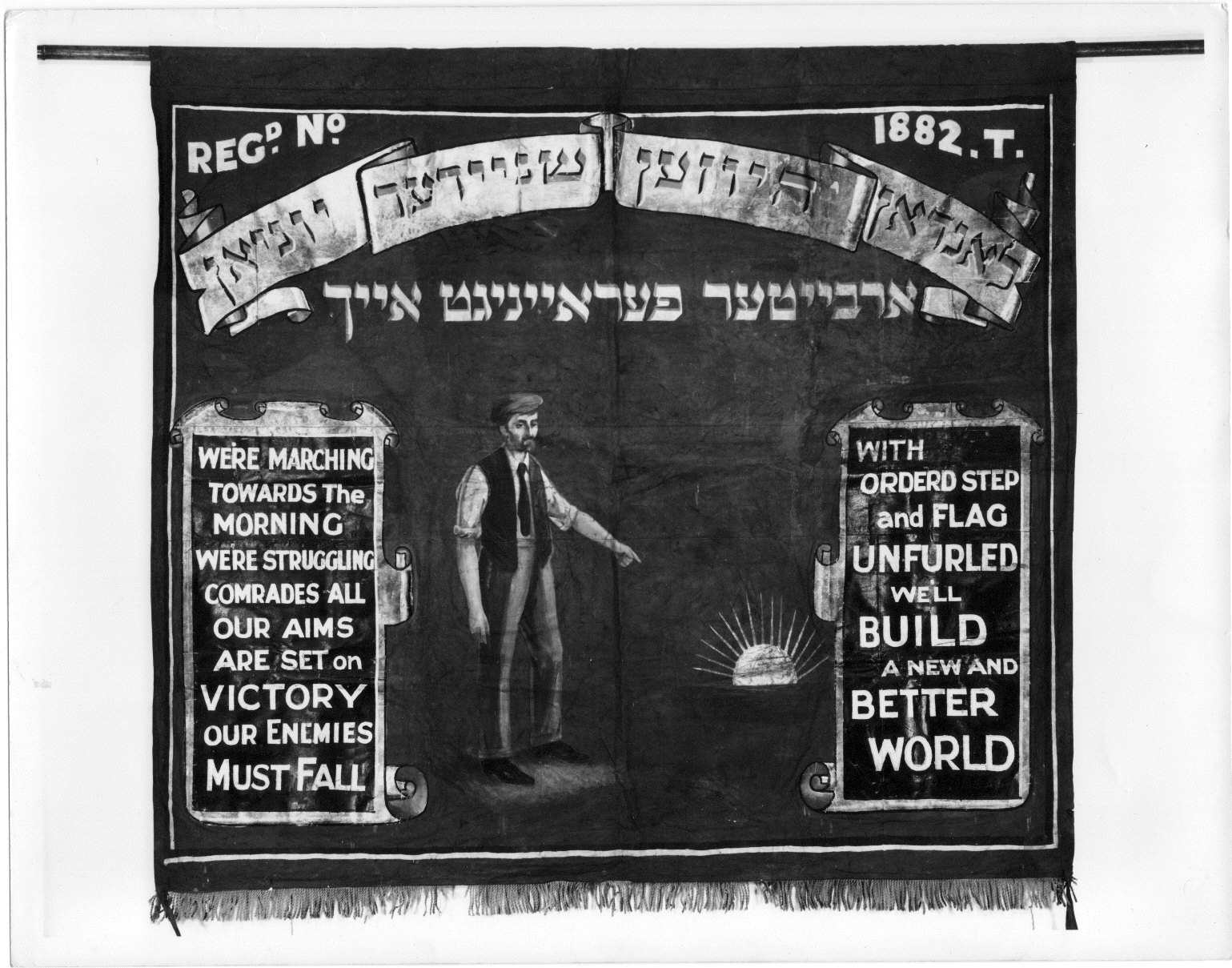
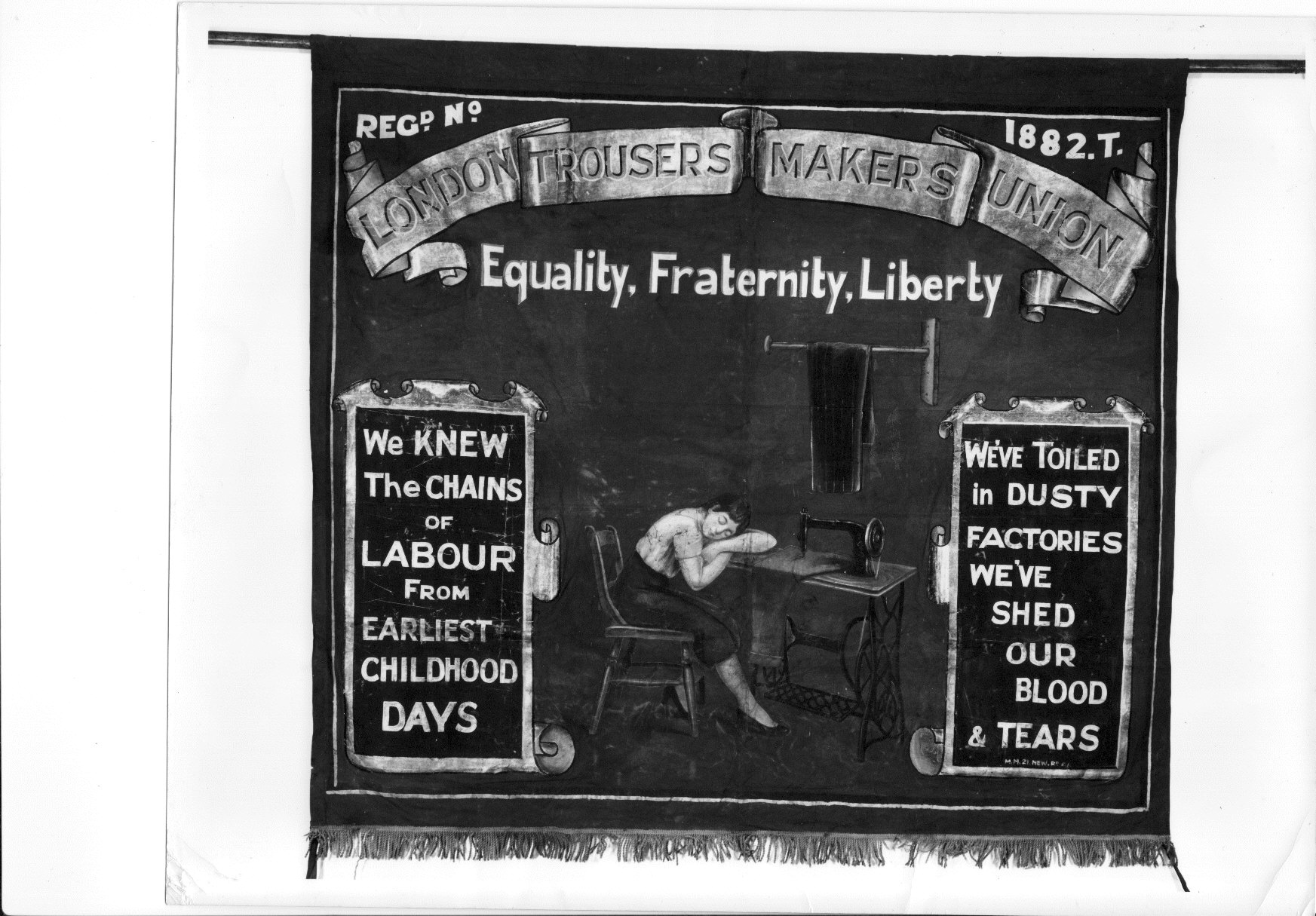
Many of the Jews in the East End were active in the Trade Union Movement.
Among the Jewish unions was the Trousermakers' Union. Their banner was in Yiddish with an English version on the obverse.
(Photographs courtesy of Harold Pollins
The following congregations were within the CITY OF LONDON (the historic "One Square Mile"), generally close to the eastern boundary, and in most instances (particularly in the later period) formed a single community together with the Jews of the East End .


The following Congregations comprised the Jewish Community of the
EAST END OF LONDON
,
all situated within the boundaries of the present
LONDON BOROUGH OF TOWER HAMLETS
.
All but four of these synagogues have now closed and several were bombed during the London Blitz.
List of Synagogue Marriage Registers held at Tower Hamlets Register Office.
 
 
 *   Active congregation.
 ◊   A congregation that subsequently changed its name or merged into another congregation.
(1) Congregation records (as listed) in All-UK Database.
(2) Pages with their own searchable databases.
(3) Pages with a press report or reports on the congregation.
(4) Pages with photographs.
(5) Pages with articles and other contributed material.
(6) Pages with browsable lists.