Tässä mainitaan Suomessa kadonneen juutalaistytön nimi Fritzl Huppert.
"muutamia kymmeniä juutalaisia sotavankeja luovutettu"
Siirrän tämän Israel blogin sivulle.
SITAATTI:
Liikemies Heinrich Huppert oli tullut Wienistä Suomeen elokuussa 1938
kahden lapsensa, teini-ikäisen tyttärensä Fritzlin ja 7-vuotiaan
poikansa Kurtin kanssa. Perheen äiti jäi Wieniin. Suomessa Huppert toimi
kiertelevänä kauppiaana, ja hän asui lastensa kanssa Helsingissä Hakaniemen torin laidalla Viherniemenkadulla. Talvisotaan hänet määrättiin autonkuljettajaksi, mutta hänet otettiin turvasäilöön, josta hänet vapautettiin sodan jälkeen. Kesällä 1940 Huppert pidätettiin epäiltynä salakuljetuksesta ja tuomittiin sakkoihin säännöstelymääräysten rikkomisesta. Huppertin ollessa kesällä 1941 matkalla Rovaniemelle
hänet otettiin kuulusteltavaksi. Hänen ei todettu syyllistyneen
mihinkään, mutta hänet päätettiin karkottaa Suomesta ”maanpetoksellisen
toiminnan” vuoksi. Valpo haki Huppertin turvasäilöstä lokakuun lopulla
1942, ja karkotuspäätökseen kirjattiin, että poika Kurt seurasi isäänsä.
Tytär Fritzl jäi Suomeen, mutta hänen myöhempiä elämänvaiheitaan ei
tiedetä.[5]
Ilmeisesti oli terrorijärjestöjen tarkoitus eskaloitua asteittain ja ja paisuttaaa invaasio yhä vahvempien yksiköiden avulla muista suunnista. Asia on edelleen tosin eskalaatiossa. Mutta Israelin kehittyvä puolustusverkosto on myös vstaamassa hyökkäykseen toisensa jälkeen ajallisesti yhä nopeammilla vasteilla. Vaikka on eliminoitujo mieletäni suunnattomia määriä vihollispesäkkeitä ja aseröykkiöitä ja invasioon kehiteltyjä tunneliyhteyksiä, purkautuu edelleen suuria, jopa suurenevia määriä ohjuksia ja raketteja joistain pimeyden aukoista. maanalaiset invaasioon takoitetut tunneliverkostot ovat varmaan toista tuhatta kilometria kokonaispituudeltaan ja tietysti niitä tehdään tai modifioidaan jatkuvasti, ehkä koetetaan nyt naamioida paremmin, koska niitä aletaan havaita. Niitä on tehty ainakin 15 vuotta. Kovaan dolomiittiin porattujen tunneleidin työstäminen israelilaisten huomamatta selittäneen sen jatkuvan metelin, mitä kiviporaustöitten avulla esim haifassa rakentajat pitivt yöt pitivät 2017 meillä oli hotelli Karmelin HAdartasossa, ja kiviporaustyöt ihmetyttivät minua. Ajattelin,että eikö väki itse kärsi sellaisesta yömetelistä, mutta tietysti jos merkitys on ollut kamouflagemeteli Asiasta tietoiset sietivät itse. . Sellaista melua ei mielestäni ole ennen koskaan ollut Israelissa, Päinvastoin pyhä ihana hiljaisuus ja kirkkaat tähtitaivaat ja kuultavat kuut.
Voi vain odottaa että ihan mistä-paikasta -tahansa voi maan pinta avautua ja tuottaa eläimellisiä kansanmurhaajia, kuten siellä Kadesh Barneassa,AlkuPyhäkön sijaintipaikassa: Kun Israel oli erämaamatkalla eli Seurakunnassa ne 40 vuotta, he itse asiassa olivat jo perillä geologisesti ja sillä alueella, joka sittemmin annettiin Juudan ja Simeonin heimoille, jotka olivat alkuvaiheissakin valmiit valitsemaan suoran tien, vaikka muun kansan tähden tuli kiertomatkaa ennen Jordanin kautta kulkua Nebon näkymiin.
Toinen perilletulo oli henkinen ja hengellinen siirtyminen valitun kansan erityisiin tehtäviin maailmankaikkeudessa ja paikallisesti Kaanan kieliperheen alueissa. Seka-avioliittoja kanaanilisten kanssa syntyi, kertoo Raamattu ja tämä taas lie edistänyt kaanaan kielien muodostumista äidinkieleksi ja käytännön kieleksi. Kanaanilaisia heimoja jäi asumaan pysyvästikin israelilaisten keskeen. Jopa UudenTestamentin ajalta on mainintoja, mistä näkee että oli hyvä kielellinen kommunikaatiokyky heimojen kesken . Jeesus kehitti kaanaan kieltä antamalla valtavasti vertauksia aivan käytännön asioista ja tavallisesta elämästä sekä sapatteina luki kirjoituksia ja selitti niitä kautta Galilean, myös Juudeassa ja Temppelissä.
Uusinta perilletuloa on nyt sitten meidan aikanamme tapahtumassa: Pimeyden ruhtinaiten viha Pyhää Kansaa kohtaan on ajsta aikaan hyökännyt Israeliin ja israelilaisten kimppuun ja Jumala itse on sirottanut kansnsa niin hajalleen maanpiiriin, että jotavallisen statistiikan mukaan jostain osasta maapalloa nousee Israelin kansa uudelleen esiin olio mikä tahansa tuho ollut tai Pimeyksissä suunniteltuna. Tämä uusin perilletulo on varsinaisesti pysymistä fyysisesti elävien kirjoissa Puolustusvoimien avulla. Israel itse pyrkii pysymään auktoriteetissaan, Jumalalle otollisena , tehtävästään kansakuntien joukossa tietoisena kansana ja puolustautuu tappajia, salamurhaajia, annihiloivia voimia vastaan eikä suostu enää kulkemaan kuin lammaslauma Kuoleman porteista.
Israelin vihollisten puheet ovat kuin avointa hautaa ja heidän silmänsä on kuin manala, jolla ei ole peitettä ja horna, joka ei kyllinsä saa pahuuksiensa kehittelystä.
Israelin uutisista jokin linkki :
i24news
* Noa Arghmani, a former hostage
who was released from Hamas captivity, marked the somber milestone of
400 days since the October 7 attacks with a poignant message on her
Instagram account.
In her
post, she expressed the deep frustration and despair felt by hostages
still held by Hamas, highlighting the emotional toll of prolonged
captivity.
On Saturday
evening, Arghmani recounted her own harrowing experience of being
kidnapped in Gaza, a traumatic ordeal that ended with her rescue during a
military operation. Reflecting on her time in captivity, she wrote, “I
can’t even describe to you the sense of frustration I felt while I was
still in Hamas captivity.” She emphasized the uncertainty and despair
that plagued her as days turned into weeks, questioning whether she
would ever return home. “When would it be my turn to go home? Had they
forgotten about me? Had they left me behind? These were sentences I said
on a daily basis,” she shared.
In
her message, Arghmani articulated the pain of seeing the days stretch
on without resolution. “But the most frustrating moment is when another
100 days are added to the previous 100 days, and that is when I start
counting from the beginning again. And even though the counting has
started again, the conditions are getting worse and the despair is
increasing,” she lamented.
* The IDF discovered ammunition
hidden in a convoy traveling between north and south within Gaza during
a security check on Monday, the military said in a Monday statement.
During
the passage of a convoy coordinated with the international community,
the IDF detected unusual movement and ordered the convoy to stop at a
checkpoint on the humanitarian aid route for inspection.
During the inspection, IDF troops discovered a bag containing ammunition for firearms.
The IDF emphasized that "This was an internal
convoy traveling inside the Gaza Strip from the north to the south, and
not through the crossings designated for bringing humanitarian aid into
Gaza."
Troops
from the IDF's Nahal Brigade, under the command of the Gaza Division,
have been conducting precise, intelligence based targeted operations and
raids on terrorist locations over recent months in the area of Rafah.
Over the course of these raids, the soldiers eliminated many terrorists.
During
activity in the area of Shabura, the soldiers located weapons storage
facilities with ammunition stockpiles left behind by the enemy.
In
one of the searches near a mosque and a hospital, a weapons storage
facility containing observation equipment, drones, enemy manufacturing
supplies, explosive devices, and dozens of mortar shells was located.
The facility was then dismantled by the brigade’s engineering forces.
Additionally,
dozens of terrorist infrastructure, armed terrorist cells, anti-tank
missiles sites, weapons storage facilities, underground infrastructure,
and more were struck by the brigade's Fire Control Center.
Israel's
Ministry of Health said that 21 people have been diagnosed with West
Nile virus, of which 17 have been hospitalized with neurological
symptoms. Of the confirmed patients, two patients died over the weekend
in Petach Tikva's Beilinson Hospital. Three patients are on ventilators.
Since
2011, most of the patients diagnosed with the West Nile virus were over
65 years old. the next most affected age group was between the ages of
45-64. As a general rule, about 80 percent of those infected do not
develop symptoms. About 20 percent of those infected will have symptoms
of varying severity, including fever, general malaise, headaches, or
generalized body aches. Neurological complications will appear in less
than 1 percent of those infected.
In
the meantime, the Ministry of Health refined instructions for the
medical teams and instructed them to emphasize the diagnosis and
monitoring of the disease. In order to reduce exposure to mosquitoes,
the Ministry of Health recommends using mosquito repellents and
appropriate accessories to keep mosquitoes away in the living rooms, as
well as turning on fans in the resting place.
West
Nile virus has affected Israel for years and occurs mainly between the
months of June and November. This year, the morbidity began earlier than
usual, likely due to climate changes in Israel and around world.
Humidity in the central part of the country may lead to increased
reproduction of mosquitoes in this area. The risk of morbidity is
highest among adults and people with immunosuppression issues.
In
cases of West Nile virus, the Ministry of Health conducts an
epidemiological investigation that is forwarded to the Environmental
Protection Ministry for local pest control operations by the
authorities. In addition, the Health and Environmental Protection
Ministries inform the public about areas where mosquitoes infected with
the virus are caught.
Derbentin synagoga paloi perustuksia myöten Wallan antaman tiedon mukaan ja vartijat saivat surmansa. Synagogissa ei ollut ihmisiä rukoilemassa terrori-iskun aikana. Ortodoksikirkossa pappi surmattiin. Poliiseja sai usea surmansa usea ja kuolleiden määrä on noussut yhdeksään tähänastisten uutisten mukaan.
(Klo on 22:11 Ruotsissa).
Useita on ilmoitettu haavoittuneiksi.
i24news kertoo uutisista englanniksi 15 minuuttia sitten.
...
Joitain aikoja siten on olut Venjällä terrori-isku konserttisaliin. Moskovan synagogaa on uhattu ja ilmeisesti siellä on voitu estää terrori-isku. Viime lokakuussa Isis-terroristit etsivät Mahachkalan lentokentällä Israelista tulevia turisteja surmatakseen heitä.
Asiasta kertoivat kansallinen terrorismin vastainen komitea ja poliisi.
Hyökkäykset
tehtiin Mahatshkalan ja Derbentin kaupungeissa. Muun muassa
suuronnettomuuksia tutkiva Venäjän tutkintakomitea sanoo tutkivansa
tapauksia terroritekoina.
Dagestanin asukkaista suurin osa on islaminuskoisia.
– Tänä
iltana Derbentin ja Mahatshkalan kaupungeissa tehtiin aseellisia
hyökkäyksiä kahteen ortodoksikirkkoon, synagogaan ja poliisin
tarkastuspisteeseen, sanoi kansallinen terrorismin vastainen komitea
lausunnossaan uutistoimisto Ria Novostille.
Hyökkäyksissä haavoittui lisäksi 12 poliisia, kertoi Dagestanin sisäministerin Gajana Garijeva Ria Novostille.
Jewish community in Dagestan: history and recent challenges - explainer
This community has preserved its distinct cultural and religious practices despite geographical and political isolation.
The Jewish community in Dagestan,
primarily consisting of Mountain Jews, has a rich history and faces
unique challenges in recent years. The Mountain Jews, also known as
Tats, trace their origins back to Persian-speaking regions and have
lived in the Caucasus since at least the 8th century.
This
community has preserved its distinct cultural and religious practices
despite geographical and political isolation. Historically, Mountain
Jews settled in various parts of Dagestan, with significant populations
in cities like Derbent and Makhachkala.
Derbent, one of the oldest
cities in the region, has been a central hub for Jewish life, boasting
multiple synagogues before the Bolshevik Revolution. Today, only the
Kele-Numaz Synagogue remains active in Derbent, serving as a focal point
for the dwindling Jewish population, according to reports.
Dagestan,
a republic in Russia's North Caucasus, borders the Caspian Sea to the
east and Georgia and Azerbaijan to the south. Its capital is
Makhachkala. Known for its ethnic diversity, with over 30 ethnic groups
and 100 languages, Dagestan predominantly practices Sunni Islam. The
region has a complex history of resistance against empires and faces
challenges like political instability and economic development, despite
its resources in agriculture, oil, and industry.
During
the Soviet era, Mountain Jews managed to maintain their religious
practices discreetly, such as baking matzo for Passover and lighting
Sabbath candles, far from the anti-Semitic policies prevalent in other
parts of the Soviet Union. This cultural resilience continued despite
the harsh conditions imposed by the Soviet regime, as noted by various
sources.
In
recent decades, the Jewish population in Dagestan has faced significant
challenges. The collapse of the Soviet Union and subsequent regional
conflicts, particularly the Chechen wars, have led to increased violence
and instability. The rise of Islamic fundamentalism has further
complicated the situation, causing many Jews to emigrate. For instance,
the Jewish population in Dagestan has plummeted from around 50,000 to
fewer than 10,000 in recent years, with many relocating to Israel, the
United States, or other parts of Russia, according to the Jewish
Telegraphic Agency.
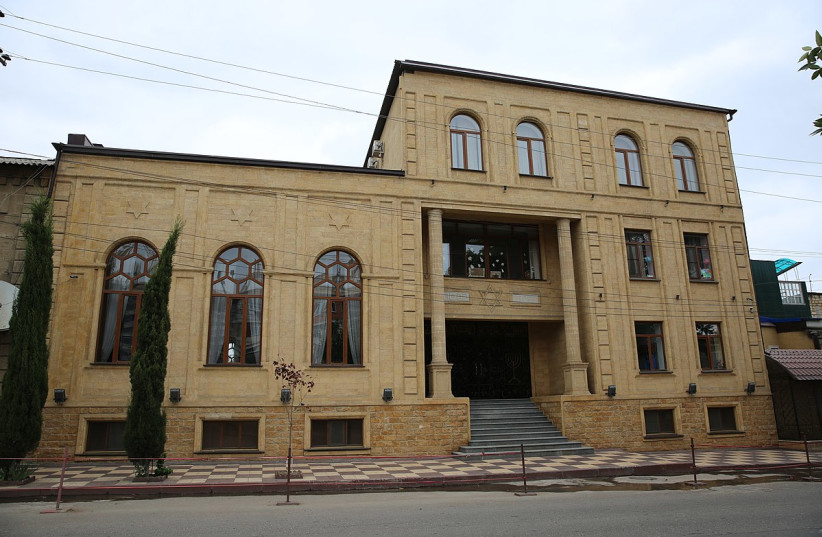
Kele-Numaz Synagogue in Derbent, Dagestan, Russia (credit: Wikimedia Commons)
Increased ethnic tensions
Despite
their drastically diminished numbers, the Mountain Jews in Dagestan and
elsewhere in the North Caucasus have maintained their communities.
However, recent years have seen an increase in interethnic tension and
acts of violence, prompting many to consider emigration for safety.
Roman Ashurov, a prominent community member, highlighted the dangers
faced, including kidnappings by Chechen gangs who targeted Jews for
ransom, as reported by the Jewish Telegraphic Agency and Radio Free
Europe/Radio Liberty.
In
recent years, the Jewish community in Dagestan has faced significant
threats, including a notable terrorist incident on October 29, 2023,
when a mob stormed Makhachkala Airport in search of Jewish passengers
arriving from Israel. This attack was incited by ongoing global
antisemitic agitation linked to the conflict between Israel and Hamas.
The mob, shouting antisemitic slogans, managed to breach airport
security and caused significant chaos, leading to the airport's
temporary closure and heightened security measures by local authorities,
according to Jerusalem Post articles.
This
incident wasn't isolated. Just earlier that day, a Jewish center under
construction in Dagestan was set ablaze, with the words "Death to the
Jews" inscribed on its walls. These events underscored a worrying rise
in antisemitic violence in the region, exacerbated by geopolitical
tensions and extremist propaganda.
Local
and international Jewish leaders have expressed deep concern about the
safety of Jews in Dagestan. Rabbi Pinchas Goldschmidt, the president of
the Conference of European Rabbis,
emphasized the need for Russian authorities to take decisive action
against such extremism. Similarly, the Coordination Center for Muslims
of the North Caucasus condemned the riots, highlighting the importance
of maintaining interfaith harmony. This perspective was shared by both
the Post and Radio Free Europe/Radio Liberty.
Despite
these challenges, the Jewish community in Dagestan, particularly in
cities like Derbent and Makhachkala, continues to strive for peace and
coexistence. However, the recent violent incidents have prompted many to
consider emigration for safety, adding to the long-standing trend of
Jewish emigration from the region due to economic hardships and security
concerns.
Posters in Tel Aviv calling for the return of Israeli hostages in Gaza
On 7 October 2023, as part of the Hamas-led attack on Israel at the beginning of the Israel–Hamas war, Hamas and other Palestinian militant groups abducted 253 people from Israel to the Gaza Strip,[1][2][3][4][5][6] including children,[7][8][9][10][11] women, and elderly people.[12] In addition to hostages with only Israeli citizenship, almost half of the hostages are foreign nationals or have multiple citizenships.[13]
The precise ratio of soldiers and civilians among the captives is
unknown. The captives are likely being held in different locations in
the Gaza Strip.[14]
As of February 14, 2024, 112 hostages were returned alive to Israel, with 105 being released in a prisoner exchange deal, 4 were released by Hamas unilaterally and 3 hostages were rescued by the IDF.[15][16][17][18][19][20] 11 bodies of hostages were repatriated to Israel, with 3 of the hostages killed by friendly fire from the IDF[21] and the bodies of 8 hostages repatriated through military operations.[22][23]33 hostages were reportedly killed in Hamas captivity according to Israel.[24][25][26][27][28]According to unconfirmed Israeli intelligence, at least 20 additional
hostages may be deceased, with their bodies being held captive in Gaza.[29]
As of February 14, 2024, 134 hostages remain in captivity in the Gaza
Strip, with 130 hostages abducted on October 7, 2023, and four hostages
having been captured earlier.[25]
Hamas has offered to release all hostages in exchange for Israel releasing all Palestinian prisoners.[30]By October 2023, Israel held 5,200 Palestinians (including 170
juveniles) in its prisons. Hamas stated its objective was to secure
their release.[31] Several countries have been involved in negotiations between Israel and Hamas, with Qatar taking the lead.[32]
On 22 November 2023, Israel and Hamas agreed to the release of 150 Palestinian prisoners and a four-day cease-fire in exchange
for Hamas's release of approximately 50 of the hostages. The exchange
involved hostages from the categories of women and children.[33][34][35]
As of 30 November 2023, the last day of the ceasefire, 105 civilian
hostages had been released, which included 81 people from Israel, 23 Thais and one Filipino.[36] On 12 February 2024, two Argentinian-Israeli civilians were rescued in Operation Golden Hand. As of March 2024, according to Israeli information, Hamas holds 107 hostages alive and 25 bodies.[24]
Militants abducted the Bibas family from kibbutz Nir Oz during the Nir Oz massacre: 9-month-old Kfir, 4-year-old Ariel, 32-year-old mother Shiri, and her 34-year-old husband Yarden.[89][90]
Shiri's parents, also abducted from their kibbutz, were later found
deceased. Efforts to release Shiri and her children during the ceasefire
between Israel and Hamas were unsuccessful, leading to claims by Hamas
that they were killed in an Israeli airstrike. The Israeli Defense
Forces (IDF) expressed doubts about these claims, amidst widespread
concern and a campaign for their release.[91][92]