Cyrus(Persian: Kuρuͽ) commonly known as Cyrus the Great and also known as Cyrus the Elder and the Sun King, was the second king of the Achaemenid Empire. Under his rule, the empire embraced all the previous civilized states of the ancient Near East, expanded vastly and eventually conquered most of Southwest Asia and much of Central Asia and the Caucasus. From the Mediterranean Sea and Hellespont in the west to the Indus River in the east, Cyrus the Great created the largest empire the world had yet seen. Under his successors, the empire eventually stretched from parts of the Balkans (Bulgaria-Pannonia) and Greece in the west, to the City of Delhi, India in
the east. His regal titles in full were The Great King, King of Persia,
King of Anshan, King of Media, King of Babylon, King of Sumer and
Akkad, and King of the Four Corners of the World. He also proclaimed
what has been identified by scholars and archaeologists to be the oldest known declaration of human rights, which was transcribed onto the Cyrus Cylinder in 539 B.C..
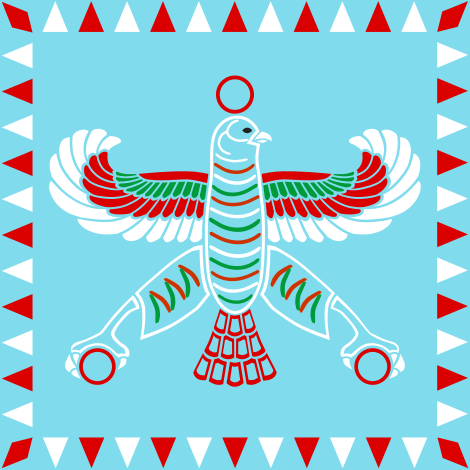
Standard of Cyrus the Great
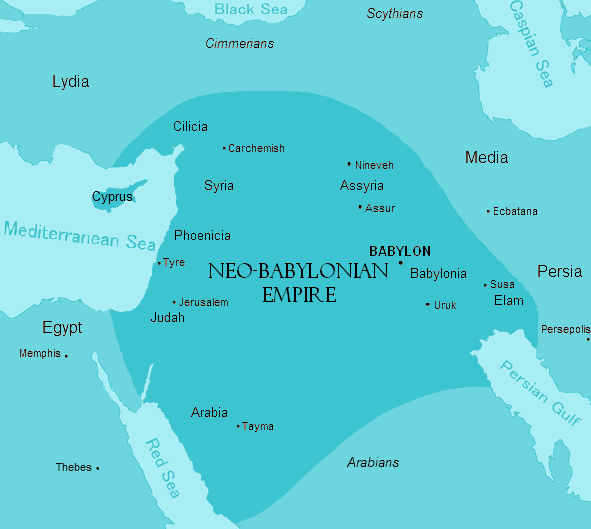
The reign of Cyrus the Great lasted 36 years. Cyrus built his empire by conquering first the Median successor state, the Lydian Empire and eventually the Neo-Babylonian Empire.
Either before or after Babylon, he led an expedition into central Asia,
which resulted in major campaigns that were described as having brought
"into subjection every nation without exception". Cyrus
did not venture into Egypt, as he refused to lead more expeditions
after the death of his wife in 530 B.C. (except for one battle one month
before his death). He was succeeded by a distant relative and high general Darius, who managed to add to the empire by conquering Egypt, the Indus Valley, Scythia and Thrace/Makedon during his rule.
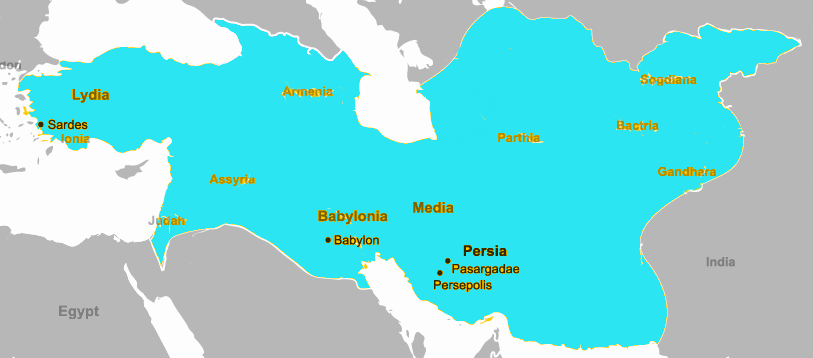
Expansion of the Empire under Cyrus
Cyrus the Great respected the customs and religions of the lands he conquered.It is said that in universal history, the role of the Achaemenid Empirefounded
by Cyrus lies in its very successful model for centralized
administration and establishing a government working to the advantage
and profit of its subjects.In fact, the administration of the empire throughsatrapsand the vital principle of forming a government atPasargadaewere the works of Cyrus.What is sometimes referred to as theEdict of Restoration(actually two edicts) described in the Bible as being made by Cyrus the Great left a lasting legacy on theJewishreligionwhere because of his policies in Babylonia, he is referred to by theJewish BibleasMessiah (Isaiah 44:24, 26–45:3, 13) and is the only non-Jew to be called so:
So said the Lord to His anointed one, to Cyrus - Yeshayahu, Isa 45:1-7
Cyrus
the Great is also well recognized for his achievements in human
rights, politics, and military strategy, as well as his influence on
both Eastern and Western civilizations. Cyrus has played a crucial role
in defining the national identity of modern Eran. Cyrus and, indeed, the
Achaemenid influence in the ancient world also extended as far
as Athens, where many Athenians adopted aspects of the Achaemenid
Persian culture as their own, in a reciprocal cultural exchange.
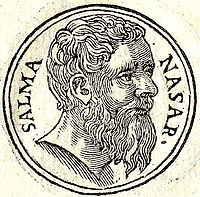
Shalmaneser V (Akkadian: Šulmanu-ašarid; Hebrew: שַׁלְמַנְאֶסֶר, ModernShalman'eser, TiberianŠalmanʼéser; Greek: ΣαλαμανασσαρSalamanassar; Latin: Salmanasar) was king of Assyria from 727 to 722 BC. He first appears as governor of Zimirra in Phoenicia in the reign of his father, Tiglath-Pileser III. Evidence pertaining to his reign is scarce. On the death of Tiglath-Pileser, he succeeded to the throne of Assyria on the 25th day of Tebet 727 BC,[1] and changed his original name of Ululayu to the Akkadian name he is known by. While it has been suggested that he continued to use Ululayu for his throne name as king of Babylonia, this has not been found in any authentic official sources.[2] The name Shalmaneser is used for him in the Bible, which attributes to him the final conquest of the kingdom of Samaria (Israel) and the deportation of Israelites. According to 2 Kings, chapters 17-18, Shalmaneser accused Hoshea, King of Israel, of conspiring against him by sending messages to Pharaoh Osorkon IV of Egypt, and captured him. Indeed, the Egyptians attempted to gain a foothold in Israel, then held largely by Assyria's vassal kings, by stirring them to revolt against Assyria and lending them some military support.[3]
After three years of siege he took the city of Samaria. The populations
he deported to various lands of the empire, (together with ones
deported about ten years earlier by Tiglath-Pileser III) are known as
the "Ten Lost Tribes" of Israel. The populations he settled in Samaria instead form, according to a commentary in the Bible, the origin of Samaritans. Shalmaneser died in the same year, 722 BC, and it is possible that the population exchanges were done by his successor Sargon II.
In the book of Tobit, chapter 1, the exiled Tobit is shown finding favor in Shalmaneser's court, only to lose influence under Sennacherib.
Since the 1930s, numerous archaeological excavations and surveys have been carried out in the Khabur Valley, indicating that the region has been occupied since the Lower Palaeolithic period.[3] Important sites that have been excavated include Tell Halaf, Tell Brak, Tell Leilan, Tell Mashnaqa, Tell Mozan and Tell Barri. The region has given its name to a distinctive painted ware found in northern Mesopotamia and Syria in the early 2nd millennium BCE, called Khabur ware. The region of the Khabur River is also associated with the rise of the Kingdom of the Mitanni that flourished c.1500-1300 BC.
The Khabur River is mentioned in 1 Chronicles 5:26 in the Hebrew Bible: "Tiglath-Pileser
... took the Reubenites, the Gadites and the half tribe of Manasseh
into exile. He took them to Halah, Habor (Khabur), Hara and the River
Gozan, where they are to this day". (NIV) The identification of the
Khabur with the Habor is not contested.
Natan Meir posts list of self-improvement tips his late wife Dafna wrote to herself and 'carried with her always.'
By Cynthia Blank
First Publish: 1/28/2016, 10:02 AM
Dafna Meir
Courtesy of the family
A week and a half after Dafna Meir was murdered at the door of her home in Otniel, her husband discovered a moving note she wrote and kept with her for self-improvement.
"These are not my hours, but I couldn't sleep," Natan wrote on
Facebook, attaching a copy of the note. "I'm touched with great
respect and longing for what Dafna left behind, and found this note in
her bag. A page of self-improvement she carried with her always."
On the note, Meir wrote a list of ways to deal with difficult
situations, such as writing down emotions before bursting into anger.
Meir asserts that it is better to leave an argument and be alone with
yourself, saying, "I apologize. I'm sorry. I will take your words to
heart. Do not try to defend in the middle of the situation, be quiet,
don't apologize in the middle of the situation, don't justify myself."
She also stressed the need to project confidence instead of
helplessness, and to understand the differences between the liminal and
the here and now.
Meir writes of interactions with others, "to smile! ask how they are!
Be polite and assertive at the same time. Don't let the situation
manage me. I am the manager."
She adds that in the middle of an interaction with another
person that is going to a bad place, it is better to stop in the middle,
request the other party to take a break and then begin again when both
sides are calmer.
Meir is survived by her husband, Natan, and their six children.
Shmita vuosi on tärkeä vmaaniljelijöille, jotak ovat ottaneet sen Isaskarin ikeen Jaakobin heimoista,
sillä heidän fyysinen taakkansa on moninkertainen verrattuna muihin amamtteihin, joten sydämen ja aivon lepoon ei riitä vain joka viikkoinen sapatti vaan siihen vaaditaan shmita vuosi. Olisi hyvä, jos sen aikana he harrastaisivat koulutuksia jossain instituutiossa, joka olisi vain heitä varten pystytetty: Shmita-noudattavien maanviljelijöiden Shmita vuosi refreshment- virkistyskoulutus- siis lähinnä mitä tahansa opetusta taia taitoa kouluttava aika tai lepovikkoja myös lomilla.
Shmita peltojen suhteen kasvu mitä itsestään tuliee, pitäisi olla myrkyttämätöntä ja sen kasvun voi tallentaa niille, joilla ei ole maaomaisuutta , jotka tulevat poimiaan kuitenkin saatuaan luvan Shmitaa peltoja tutkivalta järejstöltä ja saatuaan tietää missä on Shmita tuotetta antina köyhemmille. - kosheria tuotetta - antavat siitä sitten lantin vapaaehtoisesti viljelijäperheelle tai jos ei ole antaa mitään, siunauksensa.
Shmita vuoden tulisi olla kuitenkin iloinen asia- joka pidentää maanviljelijöiden elinikää ja estää rasitustautien kertymistä juuri heidän osalleen.
Maanviljelys ja karjanhoitoammatissa ei ole varsinaista sapattia- koska karjalla ja kasveilla on niitä tarpeitaan . Siksi Shmita vuosi on ihmsen terveyden suojelemiseki burn out- oireyhtymältä. Arvelen että Jumala ei ole mitenkään ihastunut jos sato tuhotaan, se minkä Hän antaa kasvaa ilman kyntöä ja kylvöä- vaan se tulee antaa uskoville köyhille, jotka sen poimivat itse. Jumalahan niistä tuotteista silloin itse vastaa.